
book introduction
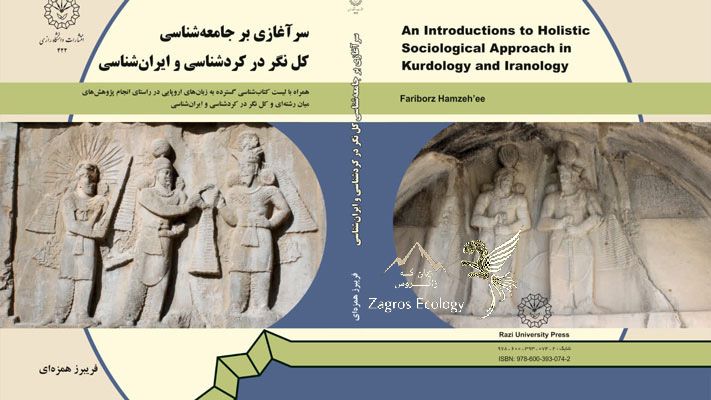
An Introdution to Holistic Sociological Appraoch in Kurdology and Iranology,1404
دی
An Introdution to Holistic Sociological Appraoch in Kurdology and Iranology
Publication of the Organization for Indigenous Knowledge and Oral Traditions of Western Iran, No. 58
An Introdution to Holistic Sociological Appraoch in Kurdology and Iranology
&
Lexicography in Cultural Sociology, as well as List of Journals and Cultural Institutions related to holistic researches
In the fields of Iranology, Kurdology and Ethnicity In European Languages
Fariborz Hamzeh’ee
(PhD, Dr. phil, PD, Dr. habil.)
Razi University Press
2026
Introdution to Holistic Sociological Appraoch in Kurdology and Iranology & Lexicography in Cultural Sociology,
Despite inheriting one of the richest cultures of the world, the Kurds are known mostly due to their bravery and warlike qualities. One of the reasons for such phenomenon is the historical fact that despite their warlike qualities, except in two short periods, they were not able to establish an impire in a large area. Fredrik Barth sees the reason for this phenomenon in the social organization of the Kurds.
According to Barth endogameous marriage among the Kurds has prevented them to create a large military power.
But social organization is a part of the culture in each region. From sociological point of view, by culture we mean all those created by humanbeings that are needed for their survival in their natural environment. Therefore, before the spread of capitalist modernity, different cultural environments were in direct relation with their natural environments. Consequently, there existed different cultural ecosystems, created to be able to live in different natural ecosystems.
In a vast region inhabited by different peoples known as the Kurds, from Zagros mountain chain to Meditaranian, perhaps much more than one cultural ecosystems exited. At any case, the type of natural conditions of an ecosystem, used to impose itself on the creation or emergence of the required material and non-material cultures.
Introdution to Holistic Sociological Appraoch in Kurdology and Iranology
In the mountianeous regions for instance, one of the modes of production was a mixture of agriculture and cattle breeding, practiced with yearly horisantal migrations. This was an efficient sustainable way of making use of agricultural and grazing lands. Endogameous marriage must have been found suitable for keeping the members and manpower within such moving peasant societies.
Before the invasion of modernity, cultural ecosystems were directly corresponding to natural ecosystems. As a matter of fact, this was the reason for their sustainability. It consisted of all human creative activities; from agriculture to architecture and from social organizations to art and religion. This makes subjects like Iranology and Kurdology interdisciplinary in nature. If it is supposed that such subjects, invetigate the culture of peoples inhabiting a certain region, then it should focuse on all or at least several aspects of their life in the past and present.
The structure of educational institutions in the so-called Third World (or periphary of capitalism), is either imposed by colonial powers or has been copied blindly. The whole educational system is therefore based on capitalitist ideology. It is a system of specialization and reductionist world view based on short term interests.
Introdution to Holistic Sociological Appraoch in Kurdology
Such imposed or copied educational system in these countries is mostly inefficient because of the lack of necessary native cultural background. For that sake, interdisciplinary holistic education in such societies, needs very long time even if it at all is supposed to be copied after the Western countries. Even in Europe it has only recently been reported that the University of Munich is planning to slowly become interdisciplinary.
Despite of pessimistic prospectives, it is attempted here to start a theoretical dialogue for the foundation of holistic and interdesciplinary Kurdology and Iranolgy. In addition to that, a relatively extended lexicography (of books and researches) in European languages is presented for those researchers who like to work in such fields. These are firstly books and articles in English, German and French languages and only in few subjects. Although there exit several lexicographies in Persian, up to now such collection in West European languages is rare or perhaps non-existent.
Appraoch in Kurdology and Iranology &Lexicography in Cultural Sociology,
The lexicography presented here is the result of many years of searching in German libraries; within the fields of Iranology or Iranian studies and Kurdology.

Germans used to call their country the “Land of Poets and Philosophers”; both of which has to do with books. Germany can really be called the Land of Books. Even in this era of digital communication, for any person coming from a Third World country, it is especially interesting to see people sitting in airports, railway stations or cafes deeply busy with reading books. If you are coming from places where even university professors do not read; it is still more surprising.
But it may no more be surprising if like me, you have lived in Germany for more than 30 years, and have never entered a house where one or two walls of the livingroom had not been covered with books. Therefore, it is normal for such a person to consider that country a “Land of Books” and even culture; even if this person is aware that there are also many millions of people in this country who never read.
Introdution to Holistic Sociological Appraoch in Kurdology and Iranology
Therefore, any amount of time spent on searching books in German libraries, being among many other people interested in books, could not really be considered as a difficult task; also remembering our ancestors who had to take much pain to find a good book.
There may be very few books in the collection here that I personally have not gone through, read or even due to high price of photocopying for me, at least partly beeing written down per hand.
It is necessary to mention once more that this lexicography contains only those writings and researches that have mostly been written in three main European languages i.e. English, German and French.
This includes books written in other languages like e.g. “Russian” that have been translated into these three. But still some few books or articles written in other European languages, as well as few Persian and Arabic books published in Europe could be found here. These books usually have important introductions in European languages. The only non-Western European language in which important researches in Iranology and Kurdology have been published is Russian. But many of these books and articles have also been translated into above three European languages.
Appraoch in Kurdology and Iranology
For many reasons, Russians became engaged in researches about Iran before the October Revolution of 1917. There are several prominent Russian scholars such as Vladimir Minorsky and Sonne whose works were written either in English or were translated into West European languages. Vladimir Ivanow wrote many of his works in English.
For many years of reseach, I have used also several historical and other books in Persian and Kurdish. But it was decided not to include such books in this collection. I suppose such books can be found in relevent lexicographies.
Theories of Development and Underdevelopment
The Yaresan By Fariborz M. Reza Hamzeh’ee
This post is available:


